Climate Insights

Seasonal rainfall across the Murray-Darling Basin can be strongly influenced by several major climate systems operating across the Pacific and Indian Oceans.
Monitoring these drivers can provide valuable signals about the likelihood of wet or dry conditions across the basin.

LATEST CLIMATE BRIEFINGS

Weather Outlook

Recent rainfall has improved soil moisture but largely missed key southern catchments. With drier conditions emerging, the window for meaningful inflows is continuing to narrow.

Weather Outlook

Climatic indicators across the Southern Murray–Darling Basin continue to present a mixed short-term picture, with rainfall opportunities in the near term but an increasingly dry signal developing as the season progresses toward winter.
  • Upload-cloud Upload-cloud

    EL NIÑO - SOUTHERN OSCILLATION (ENSO)

    ENSO

    The ENSO cycle describes fluctuations in sea surface temperatures across the tropical Pacific Ocean.

    El Niño: Often associated with drier conditions across eastern Australia
    La Niña: Typically increases rainfall across eastern Australia

  • Back Back

    INDIAN OCEAN DIPOLE (IOD)

    IOD

    The Indian Ocean Dipole reflects temperature differences across the western and eastern Indian Ocean.

    Positive IOD: Often linked to reduced winter and spring rainfall in southern Australia
    Negative IOD: Typically associated with wetter conditions

  • Flag Flag

    SOUTHERN ANNULAR MODE (SAM)

    SAM

    The Southern Annular Mode describes shifts in the westerly wind belt surrounding Antarctica.

    Positive SAM: Often increases rainfall across eastern Australia in summer
    Negative SAM: Can increase rainfall across southern Australia in winter

Why Climate Matters for Water Markets

Seasonal climate conditions play a major role in shaping water availability across the Murray-Darling Basin.

Rainfall patterns influence catchment inflows, irrigation demand and ultimately allocation announcements across the southern connected system.

Changes in large-scale climate drivers can therefore have important implications for both water supply and market behaviour.

El Niño

El Niño is a phase of the El Niño–Southern Oscillation (ENSO) marked by weakened or reversing trade winds and a shift of warm ocean water from the western Pacific toward the central and eastern Pacific.

Under typical (neutral) conditions, warm water pools near northern Australia, driving evaporation, cloud formation, and rainfall. During El Niño, this warm pool shifts eastward toward South America, reducing convection and moisture availability over Australia.

This large-scale shift in ocean temperatures and atmospheric circulation has a well-established influence on Australian climate, particularly across the southern and eastern regions.

Typical impacts include:

  • Below average rainfall across much of eastern and southern Australia, especially during winter and spring

  • Reduced inflows into key catchments, impacting storages and water availability across the Murray–Darling Basin

  • Declining soil moisture and increased evaporation, which can compound dry conditions

  • A later, weaker, or less reliable northern wet season

  • Higher daytime temperatures and an increased likelihood of heat events in southern regions

  • Increased bushfire risk, particularly following extended dry periods

The influence of El Niño is typically strongest from late autumn through spring, when rainfall deficiencies are most pronounced. From November onwards, its impact on rainfall generally weakens, and by summer the influence is often limited, although dry conditions may persist due to earlier deficits.

El Niño events occur every 3–5 years and usually last around 12 months, although their intensity and duration can vary. Even after the event has ended, impacts on water resources, agriculture, and soil moisture can continue for many months.

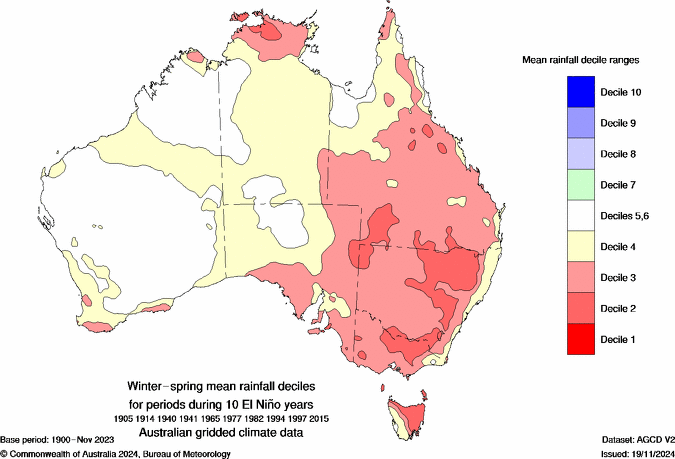
Winter / Spring Rainfall

Winter/Spring rainfall has historically been below average (deciles 2–3) across much of eastern Australia throughout El Nino years.

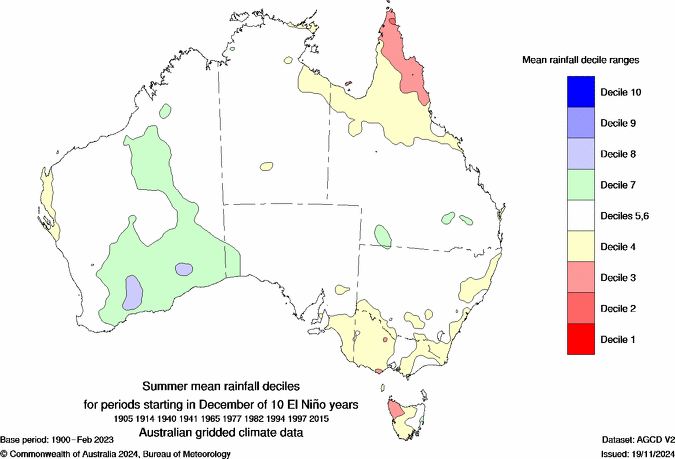
Summer Rainfall

From November onwards, the influence of El Niño on Australian rainfall typically weakens, with limited impact over summer, especially later in the season.

La Niña

La Niña is the opposite phase of the El Niño–Southern Oscillation (ENSO), characterised by stronger-than-average trade winds that push warm ocean water toward northern Australia and enhance the upwelling of cooler water in the eastern Pacific.

This reinforces the typical Pacific Ocean pattern, concentrating warm water, moisture, and rising air near Australia. The result is increased cloud formation, more frequent rainfall, and a generally wetter climate pattern across large parts of the country.

Typical impacts include:

  • Above average rainfall across eastern and central Australia, particularly during winter and spring, often extending into summer

  • Increased inflows into river systems and storages, supporting higher water availability

  • Higher soil moisture and reduced evaporation stress, benefiting agricultural production

  • An earlier and more active northern wet season, with increased tropical rainfall

  • A greater likelihood of widespread rain events, flooding, and catchment runoff

  • Cooler daytime temperatures across many inland and southern regions due to increased cloud cover

The influence of La Niña is often sustained, with impacts building through winter and spring and frequently continuing into summer. In some cases, back-to-back or multi-year La Niña events can occur, leading to prolonged periods of above average rainfall and elevated storage levels.

La Niña events occur every 3–7 years and typically last around 12 months, although around half extend into a second or even third year. These longer-duration events can have significant cumulative impacts on water systems, agriculture, and flood risk.

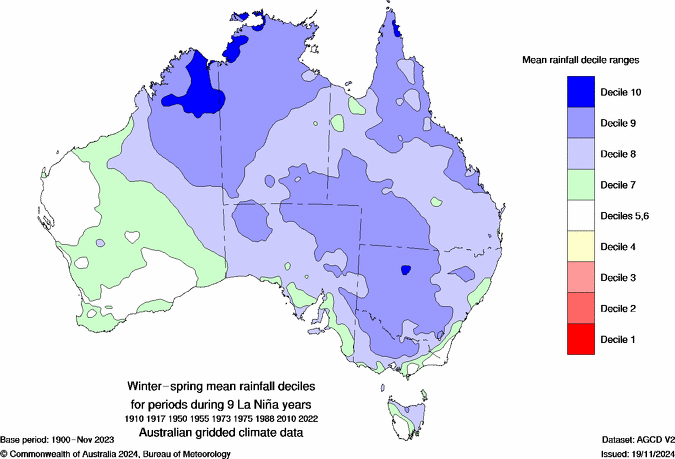
Winter / Spring Rainfall

.

.

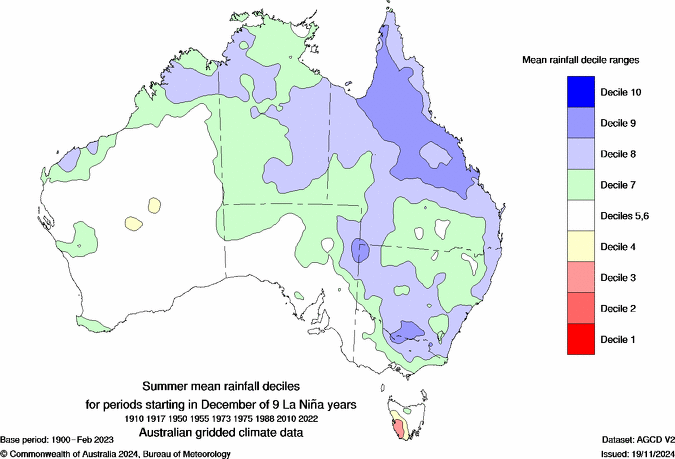
Summer Rainfall

.

.

Indian Ocean Dipole (IOD)

The Indian Ocean Dipole (IOD) is a major climate driver that influences rainfall and temperature patterns across Australia, particularly during the winter and spring months.

The IOD is defined by differences in sea surface temperatures between the western Indian Ocean (near Africa) and the eastern Indian Ocean (near Indonesia and north-west Australia). These temperature differences influence atmospheric circulation, moisture availability, and the behaviour of weather systems moving across the country.

IOD events typically develop in late autumn or early winter (May-June), peak between August and October, and then break down rapidly with the arrival of the northern monsoon in late spring.

The IOD has three phases:


Neutral IOD

During a neutral phase, sea surface temperatures across the Indian Ocean are close to average. Warm water remains near north-western Australia, supporting typical evaporation and moisture supply to the atmosphere.

  • Limited influence on Australian climate
  • Weather patterns generally reflect seasonal averages
  • Moisture supply to frontal systems remains near normal

Positive IOD

A positive IOD occurs when waters near north-west Australia become cooler than average, while warmer water shifts toward the western Indian Ocean near Africa.

This reduces evaporation and moisture availability to weather systems approaching Australia, often leading to:

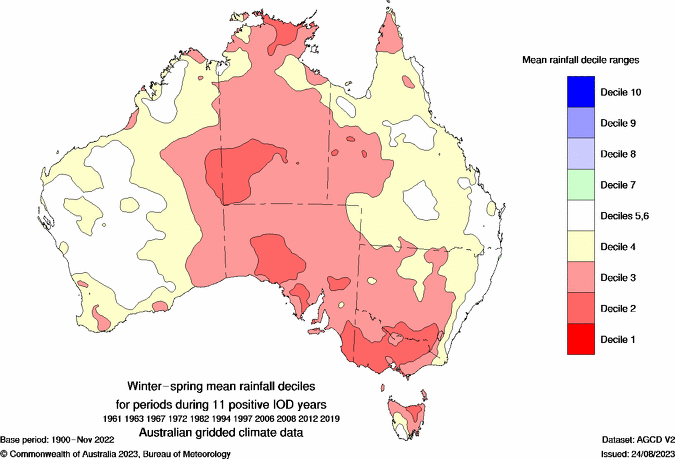
  • Below average rainfall across southern and eastern Australia during winter and spring
  • Reduced cloud cover and drier air, particularly over the southern cropping regions
  • Higher daytime temperatures and increased evaporation
  • Lower inflows and runoff, impacting water storages and allocations

Positive IOD events are often associated with drier seasonal conditions, particularly across key agricultural regions of southern Australia.


Negative IOD

A negative IOD occurs when waters near north-west Australia are warmer than average, increasing evaporation and atmospheric moisture.

This typically enhances the ability of weather systems to generate rainfall as they move across the country, resulting in:

  • Above average rainfall across southern and central Australia during winter and spring
  • Increased cloud cover and moisture availability
  • Higher likelihood of widespread rain events and runoff
  • Improved inflows into catchments and water storages

Negative IOD events are often linked to wetter growing seasons, particularly across southern Australia, and can play a key role in boosting water availability.


While the IOD is a critical driver of Australia’s cool-season climate, it interacts with other systems such as El Niño-Southern Oscillation, meaning overall seasonal conditions depend on how these climate drivers combine.


Winter / Spring Rainfall

.

.

Member Access

Deeper allocation modelling, detailed trade breakdowns and historical datasets available to members.

© Copyright - The Basin Brain