Weather Outlook
Climatic indicators across the Southern Murray–Darling Basin continue to present a mixed short-term picture, with rainfall opportunities in the near term but an increasingly dry signal developing as the season progresses toward winter.
March 10, 2026 | The Basin Brain
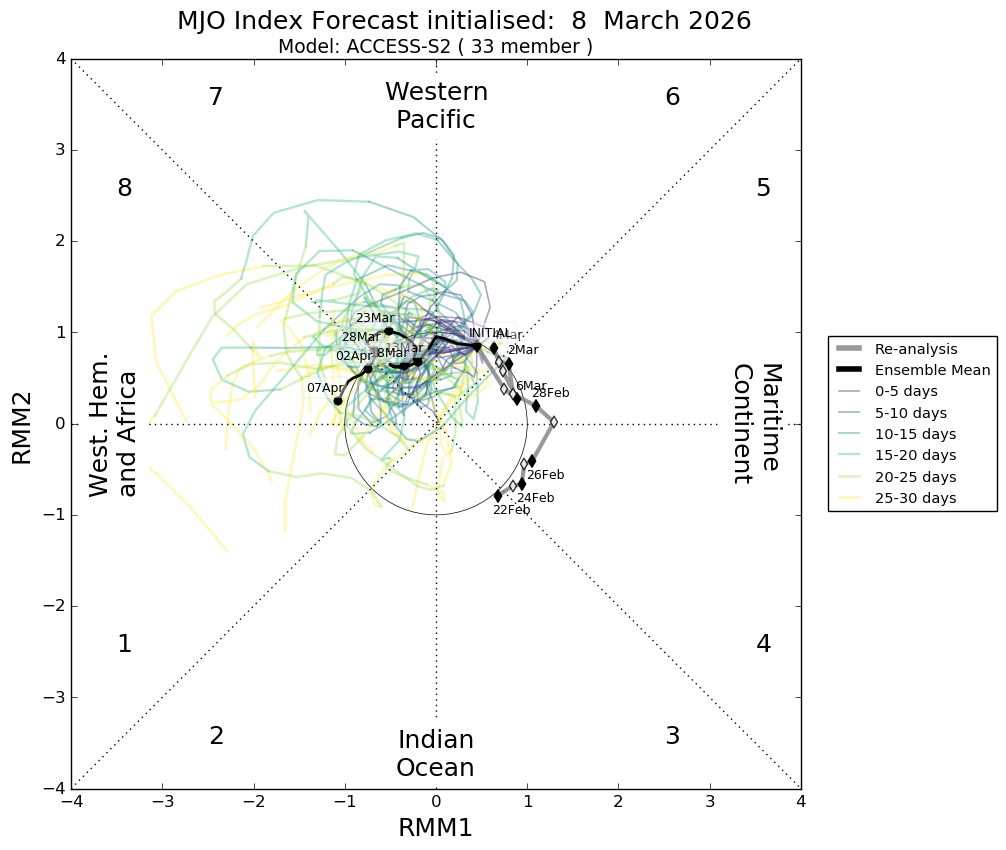
Over the coming few weeks, rainfall probabilities remain relatively balanced, with much of the Basin sitting near historical averages for the chance of exceeding median rainfall. Atmospheric conditions are currently being influenced by the Madden-Julian Oscillation (MJO), which is positioned in Phase 7 and forecast to progress into Phase 8 in the coming weeks. Historically, this phase progression is less supportive of rainfall across eastern Australia during the late summer to early autumn period, often favouring drier conditions across southern catchments.
While this does not preclude rainfall events, it suggests that opportunities for widespread or sustained rainfall may become less frequent as the pattern evolves.
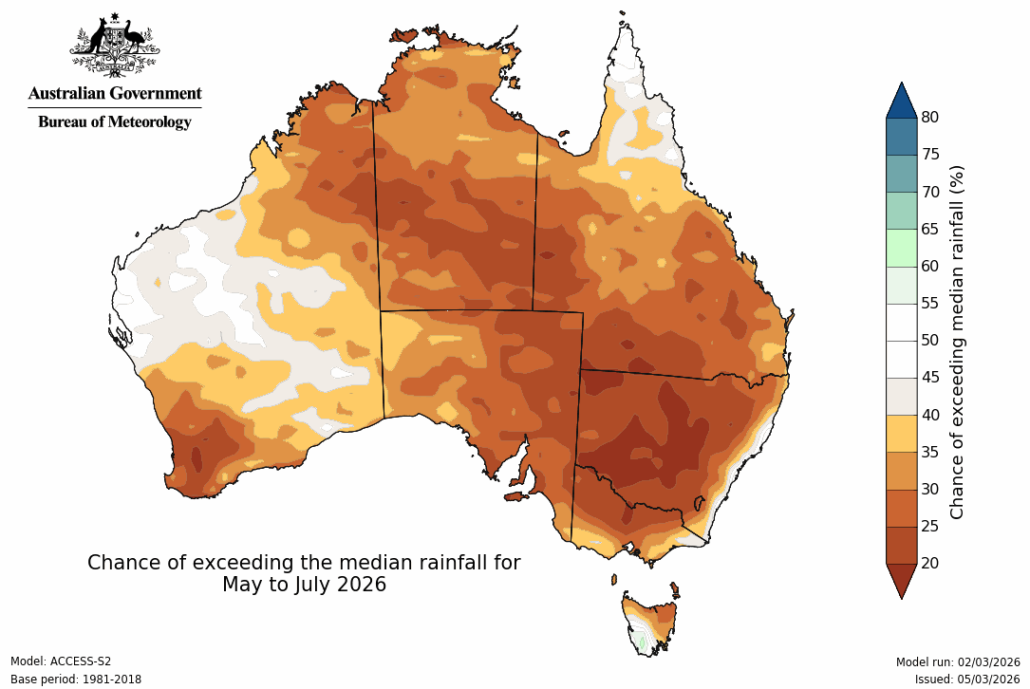
Seasonal outlook guidance reinforces this emerging bias. Forecast modelling indicates that much of southern Australia is likely to experience below-average rainfall probabilities through April, with large parts of the Murray-Darling Basin showing only around a 30-40% chance of exceeding median rainfall. This dry signal strengthens further when looking beyond the immediate outlook.
Through the April to June period, probabilities across much of the Basin fall into the 25-35% range, suggesting a greater likelihood of rainfall totals finishing below the historical median. By May to July, the outlook continues to lean dry across many southern catchments, coinciding with the early stages of the winter inflow season that typically initiates reservoir recovery.
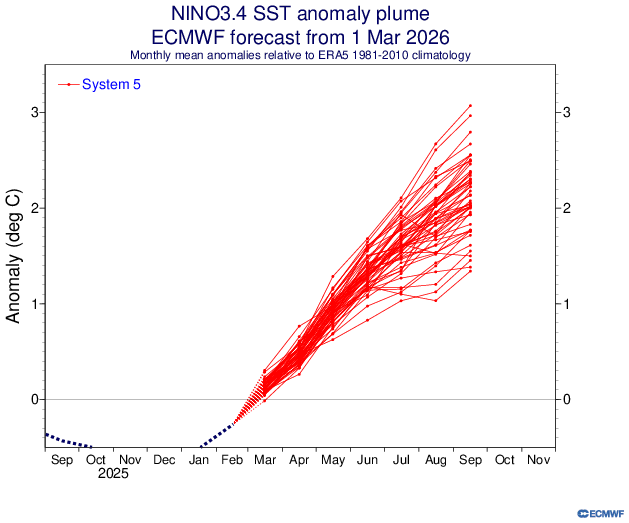
Oceanic drivers are also beginning to align toward a drier bias. The Indian Ocean Dipole is currently showing a slight positive signal, which historically correlates with reduced rainfall across southern Australia during the winter and spring months. At the same time, climate models are increasingly indicating a relatively rapid transition toward El Niño conditions during late autumn or early winter.
Taken together, these climate drivers point toward a period where rainfall opportunities may become less reliable just as the Basin approaches the critical inflow window.
From a water supply perspective, these signals carry particular significance. Major storages across the Southern Basin are currently sitting at relatively low levels for this stage of the cycle, increasing the system’s reliance on catchment rainfall to generate meaningful inflows.
Recent rainfall has improved soil moisture conditions across a number of catchments, which increases the likelihood that follow-up rainfall events could generate runoff more efficiently. Wet catchments are typically more responsive, allowing rainfall to convert into inflows rather than being absorbed into dry soils.
However, without further rainfall across these now-wet catchments, inflow generation may remain limited. The next several weeks therefore represent an important window. Continued rainfall during this period would help consolidate recent moisture gains and improve runoff potential ahead of winter.
Absent that follow-up rainfall, the Basin risks entering the winter inflow period with catchments beginning to dry again – a scenario that could further constrain storage recovery and heighten the system’s sensitivity to rainfall outcomes later in the season.