Weather Outlook
Recent rainfall has improved soil moisture but largely missed key southern catchments. With drier conditions emerging, the window for meaningful inflows is continuing to narrow.
March 19, 2026 | The Basin Brain
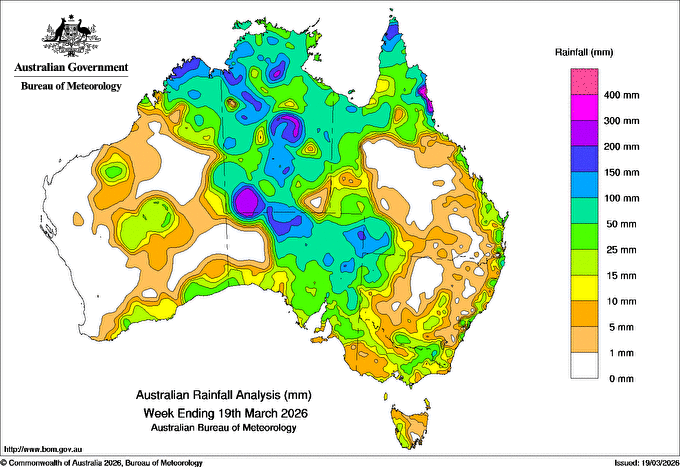
Over the past fortnight, rainfall outcomes across Australia have been mixed, broadly aligning with the expectation of increased variability rather than widespread, soaking events. While parts of the eastern and northern Basin recorded moderate to locally heavy falls, the distribution of rainfall has again proven uneven, with many of the key southern Murray-Darling Basin catchments receiving only light and patchy totals.
In this respect, the previous outlook has largely verified in direction. Rainfall has occurred, and in some cases exceeded average across inland and northern regions, but critically, much of this activity has been displaced away from the southern inflow zones. As a result, while there has been some improvement in soil moisture across parts of the Basin, the rainfall has not translated into meaningful or widespread inflow generation.
This distinction remains important. Improved soil moisture conditions mean that catchments are now more responsive, and any follow-up rainfall would have a higher likelihood of converting into runoff. However, without that follow-up, these gains can erode relatively quickly, particularly as temperatures remain warm and evapotranspiration rates stay elevated through early autumn.
Looking at rainfall over March to date, totals appear reasonable across broad areas of the country, with some regions recording above-average conditions. However, this continues to mask a key spatial imbalance. Northern and inland regions have dominated rainfall totals, while southern catchments, particularly across northern Victoria, the NSW Murray, and South Australia, have remained comparatively drier. From a water supply perspective, this limits the effectiveness of recent rainfall in supporting storage recovery.
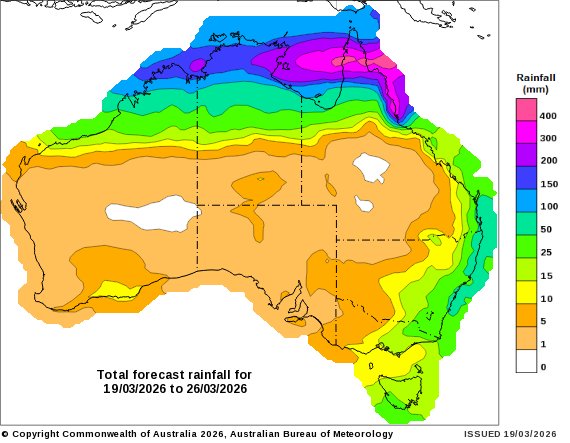
The short-term outlook offers limited encouragement for southern catchments. Forecast guidance over the coming week suggests rainfall will remain focused across northern Australia and parts of the eastern seaboard, with only light and isolated falls expected across much of the southern Murray-Darling Basin. This pattern reduces the likelihood of meaningful runoff events in the near term and increases the risk that recently improved soil moisture conditions begin to decline.
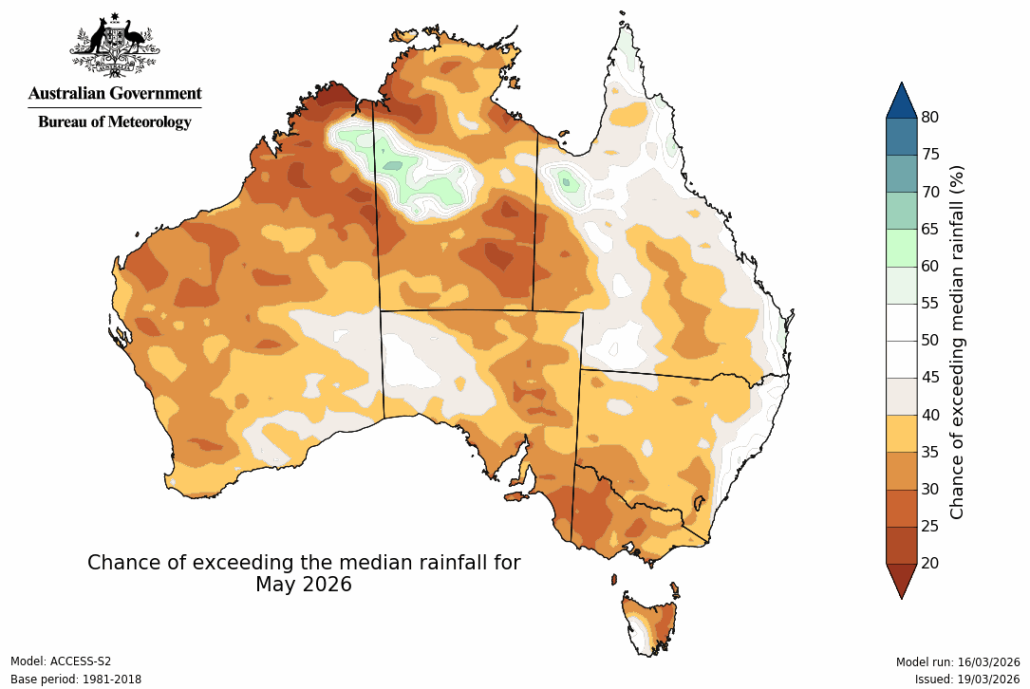
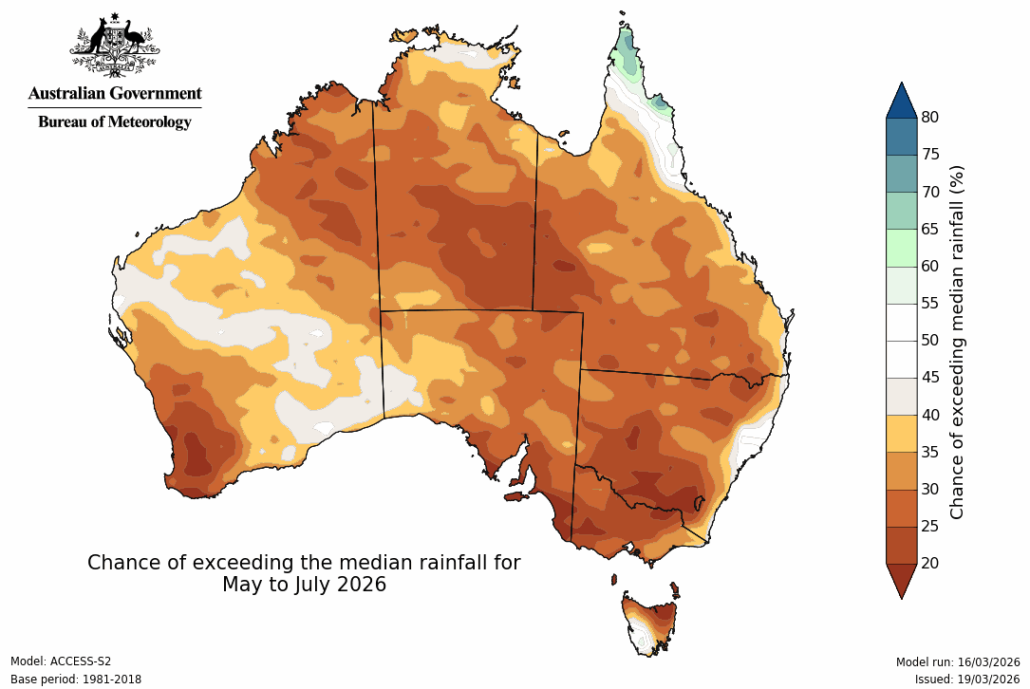
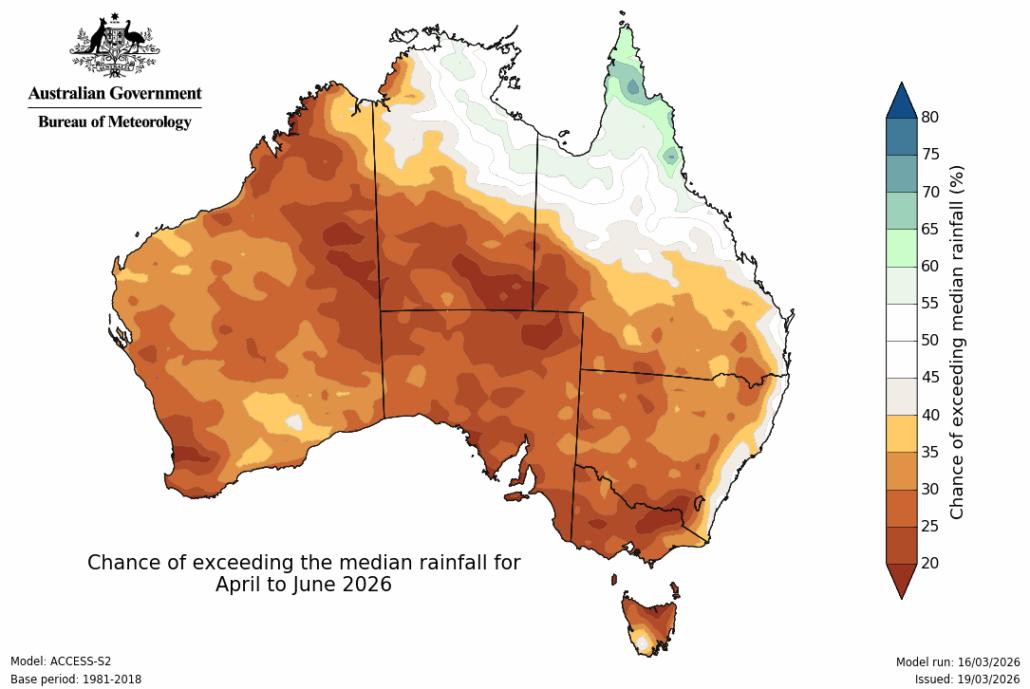
Seasonal outlooks have also shifted more decisively toward a drier bias. Through April to June, much of southern Australia is now forecast to have only around a 25–40% chance of exceeding median rainfall. This signal persists into the May to July period, encompassing the early stages of the winter inflow season. Such probabilities suggest that below-average rainfall is more likely than not across many of the Basin’s key southern catchments during this critical period.
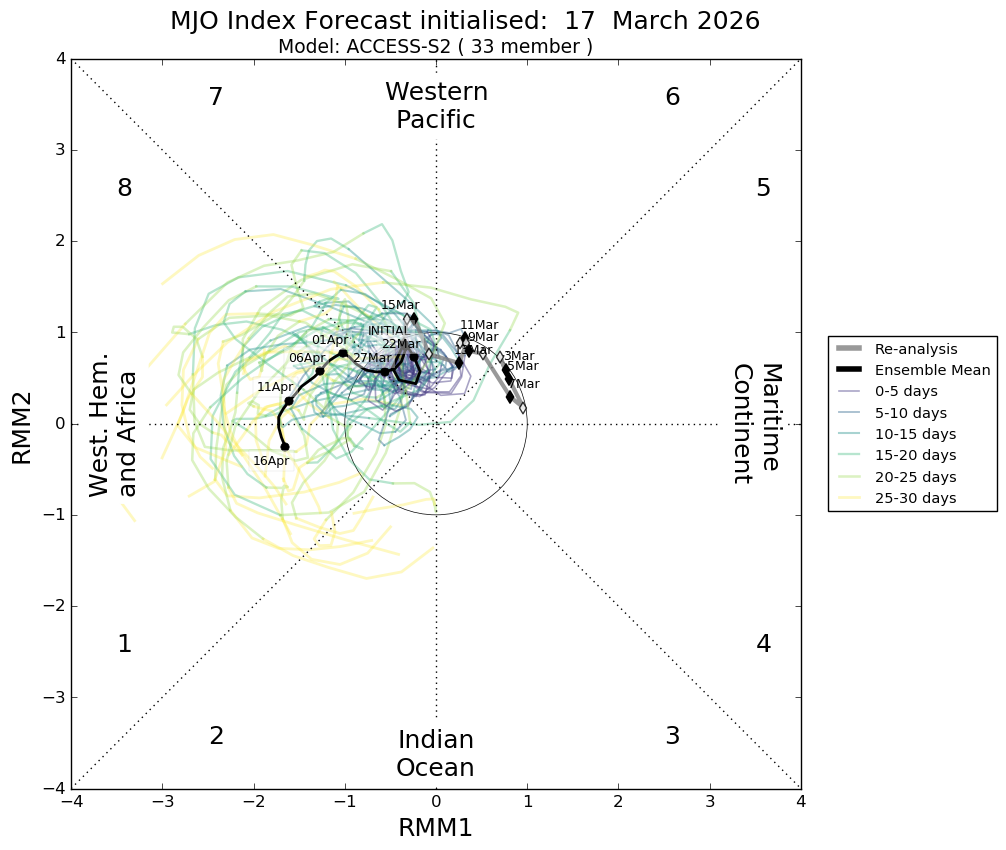
Climate drivers are increasingly aligned in supporting this outlook. The Madden-Julian Oscillation is currently progressing through phases that are typically less favourable for rainfall across eastern and southern Australia at this time of year, and is forecast to weaken as it moves further into the western hemisphere. This reduces the likelihood of organised tropical moisture contributing to inland rainfall events.
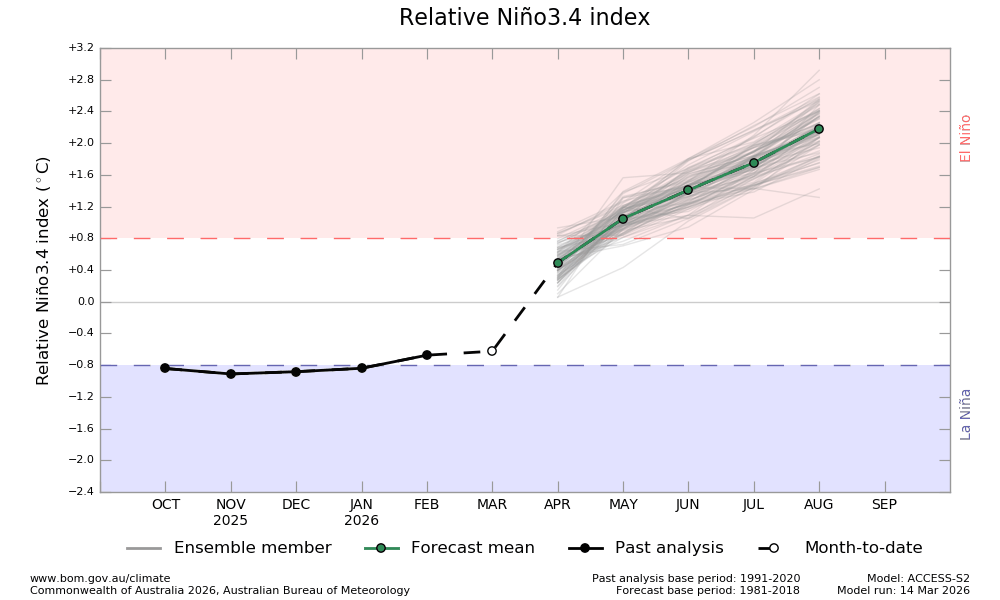
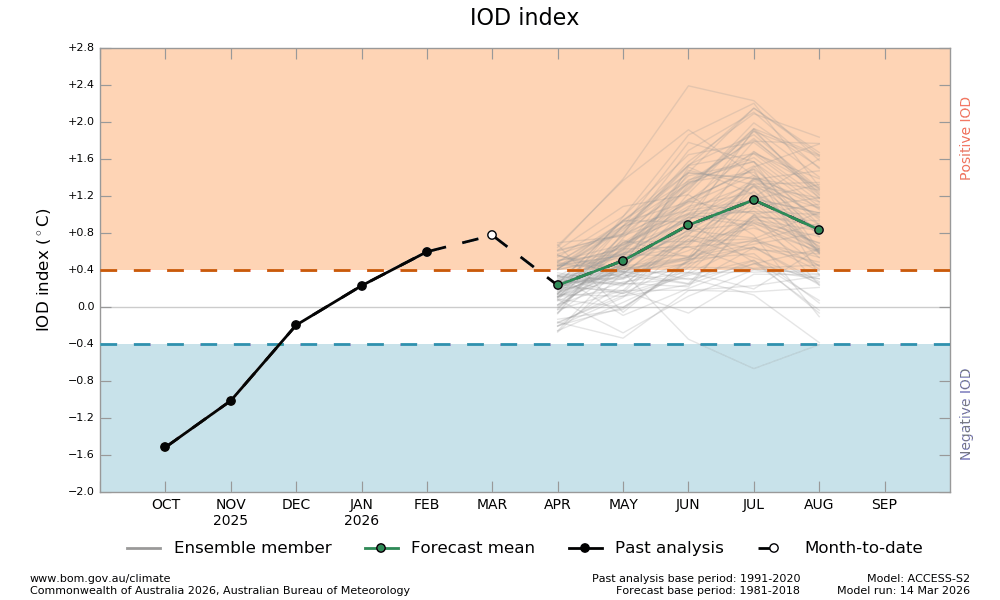
At the same time, the Indian Ocean Dipole is showing early signs of shifting toward a positive phase. While still developing, this pattern is historically associated with reduced rainfall across southern Australia during winter and spring. Importantly, climate models are also indicating a relatively rapid transition toward El Niño conditions through late autumn and into winter. The combination of a positive IOD and El Niño is typically linked with a heightened risk of drier conditions across the southern Murray-Darling Basin.
The Southern Annular Mode remains broadly neutral to slightly positive, offering limited support for cold fronts penetrating into southern Australia. This further reduces the likelihood of widespread frontal rainfall contributing to early season inflows.
Taken together, these signals point toward a period where rainfall opportunities may become less reliable at a critical time in the seasonal cycle.
From a water supply perspective, the implications are becoming more pronounced. Storages across the southern Basin remain relatively low for this stage of the cycle, increasing reliance on catchment rainfall to drive inflows. While recent rainfall has improved antecedent conditions, the system now requires timely follow-up rainfall to convert that moisture into meaningful runoff.
The next several weeks therefore represent an important window. If rainfall can be sustained across southern catchments during this period, there remains an opportunity to generate early inflows and improve the starting position ahead of winter. However, if the current pattern persists, catchments are likely to begin drying again, reducing runoff efficiency and placing greater pressure on rainfall outcomes deeper into the winter period.
In summary, while recent conditions have provided some improvement, the outlook is increasingly skewed toward below-average rainfall across the southern Murray-Darling Basin. This elevates the importance of near-term rainfall and reinforces the system’s growing sensitivity to how the coming months unfold.