Indian Ocean Dipole (IOD)
The Indian Ocean Dipole (IOD) is a major climate driver that influences rainfall and temperature patterns across Australia, particularly during the winter and spring months.
The IOD is defined by differences in sea surface temperatures between the western Indian Ocean (near Africa) and the eastern Indian Ocean (near Indonesia and north-west Australia). These temperature differences influence atmospheric circulation, moisture availability, and the behaviour of weather systems moving across the country.
IOD events typically develop in late autumn or early winter (May-June), peak between August and October, and then break down rapidly with the arrival of the northern monsoon in late spring.
The IOD has three phases:
Neutral IOD
During a neutral phase, sea surface temperatures across the Indian Ocean are close to average. Warm water remains near north-western Australia, supporting typical evaporation and moisture supply to the atmosphere.
- Limited influence on Australian climate
- Weather patterns generally reflect seasonal averages
- Moisture supply to frontal systems remains near normal
Positive IOD
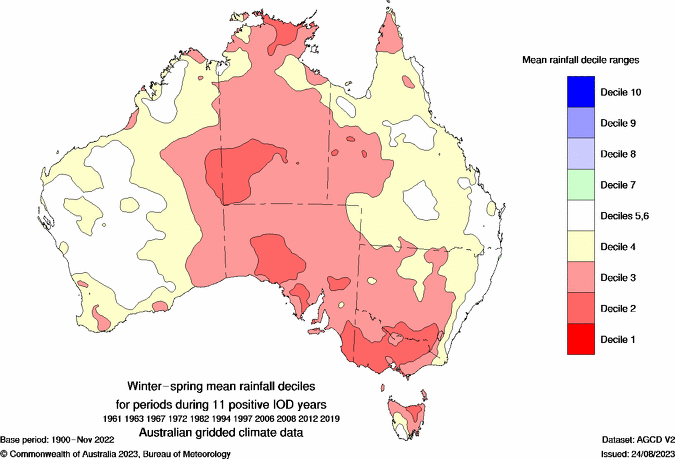
A positive IOD occurs when waters near north-west Australia become cooler than average, while warmer water shifts toward the western Indian Ocean near Africa.
This reduces evaporation and moisture availability to weather systems approaching Australia, often leading to:
- Below average rainfall across southern and eastern Australia during winter and spring
- Reduced cloud cover and drier air, particularly over the southern cropping regions
- Higher daytime temperatures and increased evaporation
- Lower inflows and runoff, impacting water storages and allocations
Positive IOD events are often associated with drier seasonal conditions, particularly across key agricultural regions of southern Australia.
Negative IOD
A negative IOD occurs when waters near north-west Australia are warmer than average, increasing evaporation and atmospheric moisture.
This typically enhances the ability of weather systems to generate rainfall as they move across the country, resulting in:
- Above average rainfall across southern and central Australia during winter and spring
- Increased cloud cover and moisture availability
- Higher likelihood of widespread rain events and runoff
- Improved inflows into catchments and water storages
Negative IOD events are often linked to wetter growing seasons, particularly across southern Australia, and can play a key role in boosting water availability.
While the IOD is a critical driver of Australia’s cool-season climate, it interacts with other systems such as El Niño-Southern Oscillation, meaning overall seasonal conditions depend on how these climate drivers combine.